
Complete Guide to Swimming Lessons for Kids in Lisbon

kidstogo

Swimming lessons are useful for far more than learning four strokes. A good programme helps a child become comfortable in water, practise getting to the surface and exiting safely, and gradually build the skills needed to swim independently.
For families in Lisbon, the choice is broad: municipal pools, parish-run facilities, clubs, private schools and individual instructors all operate differently. The best option is not necessarily the most expensive or the closest. It is the programme that matches your child's readiness, provides qualified teaching and explains its safety procedures clearly.
This guide gives you a practical framework for comparing lessons. Prices, timetables and places change between seasons, so confirm them directly before enrolling.
Quick answer: Many children can begin developmentally appropriate lessons after their first birthday, but readiness varies. Classes for babies under one may be enjoyable parent-and-child water familiarisation; they should not be presented as proof that a baby can swim or is protected from drowning.
When should a child start swimming lessons?
There is no single correct starting age for every child.
The American Academy of Pediatrics says lessons can be introduced after a child's first birthday, depending on development, health, emotional readiness and exposure to water. It also states that there is no evidence that infant swimming programmes for babies under one reduce drowning risk. Parent-and-baby water play can still be a positive shared activity when it is appropriately supervised.
The World Health Organization strongly supports teaching basic swimming and water-safety skills to school-age children as part of a wider drowning-prevention strategy. Neither organisation treats lessons as a substitute for close supervision, barriers around pools or suitable lifejackets in open water and on boats.
In Portugal you will see pools advertising adaptação ao meio aquático — water adaptation — from around six months old. It is worth understanding what that label means before you read too much into it. These are structured familiarisation sessions with a caregiver in the water: warmth, floating, songs, getting a face wet without panic. They are not swimming lessons, and no reputable Portuguese school will claim otherwise. Genuinely autonomous swimming, the point at which a child can propel themselves and recover to the surface without help, realistically arrives from about four years old, and later for plenty of perfectly normal children.
| Approximate stage | A sensible focus | What parents should expect |
|---|---|---|
| Under 1 | Parent-and-baby water familiarisation | Comfort, play and caregiver participation — not independent swimming or "drown-proofing" |
| 1–3 | Water confidence and simple safety habits | Age-appropriate entry, exit, floating and movement with very close adult supervision |
| 3–5 | Foundational aquatic skills | Following instructions, recovering balance, propulsion and progressive independence |
| 5+ | Water competency and stroke development | Returning to the surface, moving through the water, exiting safely and gradually refining strokes |
| Confident swimmers | Technique, endurance or a chosen discipline | Stroke improvement, fitness, artistic swimming, water polo or competitive pathways if the child is interested |
These are broad stages, not deadlines. A cautious seven-year-old may need a slower introduction than a water-confident four-year-old. Ask the school to assess the child rather than assigning a level from age alone.
What is currently confirmed in Lisbon
Lisbon has pools managed directly by the municipality as well as facilities managed by parish councils and other organisations. Their programmes, enrolment processes and prices are not necessarily the same.
The examples below are useful starting points, not a ranking or a complete directory.
| Facility | Verified information | What to confirm before visiting |
|---|---|---|
| Casal Vistoso Municipal Sports Complex | The official municipal page describes swimming lessons for people aged three and over, with an initial assessment and age- and level-based teaching. The published 2025/26 municipal tariff listed children's lessons once a week at 15,83 € per month, plus a first-registration charge of 26 €. | Availability, 2026/27 fees, assessment dates, waiting list and the exact timetable for your child's level |
| Oriente Municipal Pool | The official Lisbon page lists a 25-metre competition pool and a smaller teaching pool with ramp access. It also publishes general opening hours. | Whether children's lessons currently have spaces, who operates each programme, lesson fees and registration dates |
| Restelo Municipal Pool | The official listing describes a 25-metre pool and a smaller learning pool with ramp access, and provides direct contact details for the facility. | Current children's programme, operator-specific prices, accessibility support and term dates |
Two cautions on those figures. First, the 15,83 € monthly rate is from the 2025/26 municipal price table, which was still the most recent version published at the council's own address when we checked in August 2026 — the 2026/27 table may appear at any point, so treat this as the last confirmed figure rather than today's price. Second, do not apply the Casal Vistoso tariff to every pool in Greater Lisbon. Facilities managed by parish councils, clubs or private operators set their own conditions.
The Lisbon council's facility pages have also started refusing automated requests, which means third-party sites summarising them (this one included) can fall out of date without anyone noticing. Phone the pool.
Outside the city boundary
If you live west of Lisbon, Oeiras Viva runs the municipal pool network for Oeiras and publishes its programmes at oeirasviva.pt. Its pools at Barcarena, Linda-a-Velha and Outurela include baby swimming classes alongside the standard children's levels, with enrolment organised by term. Note that the network closes for maintenance in August, which catches out families planning a summer start.
How to compare swimming programmes
1. Check the instructor's Portuguese credentials
In Portugal, the official professional credential for sports coaches is the Título Profissional de Treinador/a de Desporto (TPTD), issued through the Portuguese Institute of Sport and Youth (IPDJ). It is reasonable to ask who is responsible for the programme, what swimming qualification the instructor holds and whether that credential is current.
The Portuguese Swimming Federation also operates quality and water-readiness initiatives, including school-certification work under À Prova de Água. A recognised school framework can be useful evidence, but parents should still assess the actual class, instructor and safety practices.
Avoid relying on vague phrases such as "internationally certified". Ask for the name of the qualification and the issuing organisation.
2. Ask about supervision and class size
There is no single class-size number that suits every pool, depth, age and ability level. Ask:
- How many children are assigned to each instructor?
- Is a lifeguard present separately from the teaching instructor?
- Does the ratio change for beginners or children needing additional support?
- Where does the instructor stand during the lesson — in the water, on deck or both?
- How are children counted when entering and leaving the pool?
Observe a class if possible. The instructor should be able to see and account for every child, provide useful feedback and respond quickly when someone becomes tired or anxious.
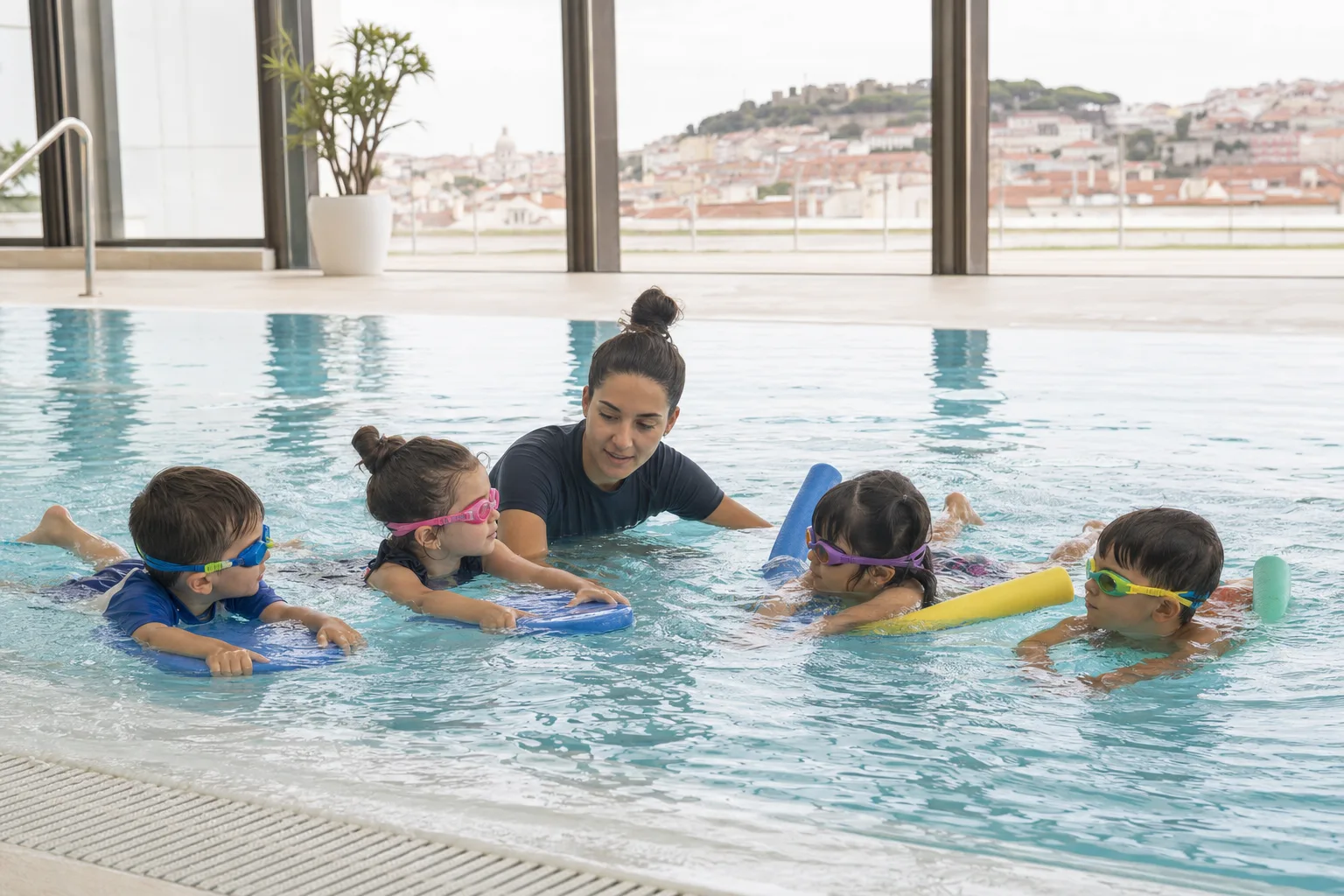
3. Look for water competency, not only attractive badges
A strong programme should progressively teach practical skills such as:
- entering and leaving the water safely;
- returning to the surface after submersion;
- floating or maintaining a position;
- turning and orienting towards an exit;
- moving through the water with increasing independence;
- understanding basic rules around pools and open water.
Certificates and coloured levels can motivate children, but ask what a completed level actually means. A child who can perform one stroke in a controlled pool still needs supervision around all water.
4. Check how the programme handles individual needs
Tell the provider about relevant health, sensory, communication, mobility or developmental needs before booking. Ask whether the programme offers adapted aquatics, smaller groups, visual instructions, a familiarisation visit or one-to-one teaching.
Do not assume private instruction is automatically better. The important question is whether the instructor has suitable experience and whether the environment supports the child.
5. Compare the practical details
| Question | Why it matters |
|---|---|
| Is there an assessment or trial session? | It reduces the chance of placing the child at the wrong level |
| Are lessons term-based or monthly? | This affects cost, commitment and cancellation options |
| What happens after an absence? | Make-up policies vary considerably |
| Can a parent observe? | Some children settle better without a visible parent; others need a gradual transition |
| Is there a teaching pool? | A warmer, shallower or ramp-access pool may suit beginners and some access needs |
| Are family changing spaces available? | This can determine whether the weekly routine is practical |
| Is a swim cap required? | Pool rules vary, so check before the first session |
| Which language does the instructor use? | Important for children who do not yet understand Portuguese confidently |
Municipal, private or individual lessons?
Municipal or parish-run lessons
These can offer good value and a clear level system. The trade-offs may include fixed enrolment windows, popular times filling quickly and less flexibility for missed sessions.
Club or private group lessons
These may offer more timetable options, smaller groups or instruction in additional languages. Compare the full term cost rather than only the advertised monthly price, and ask about registration, insurance and cancellation charges.
One-to-one lessons
Individual teaching may help a child who is very anxious, needs adapted instruction or benefits from fewer distractions. Confirm where the lesson takes place, who is responsible for pool safety and whether the instructor's insurance and professional credentials cover that setting.
Safety questions every programme should answer
Swimming lessons are only one layer of water safety. Parents should continue close, attentive supervision even when a child swims confidently.
Before enrolling, ask the provider:
- What is the emergency action plan?
- Who provides first aid and lifeguard cover?
- How are instructors' qualifications checked?
- How is water quality monitored?
- What is the procedure if a child becomes distressed or refuses to enter?
- How are children handed back to their caregiver after class?
- Are buoyancy aids used, and what skill is each aid intended to teach?
Be cautious of any programme claiming to "drown-proof" a child. Lessons improve skills; they do not remove risk.
For child-safety guidance in a Portuguese context, APSI — the Associação para a Promoção da Segurança Infantil — publishes prevention material for families at apsi.org.pt. We point you there rather than summarising it, because safety guidance is exactly the kind of thing that should come from the organisation that maintains it.
What to bring to the first lesson
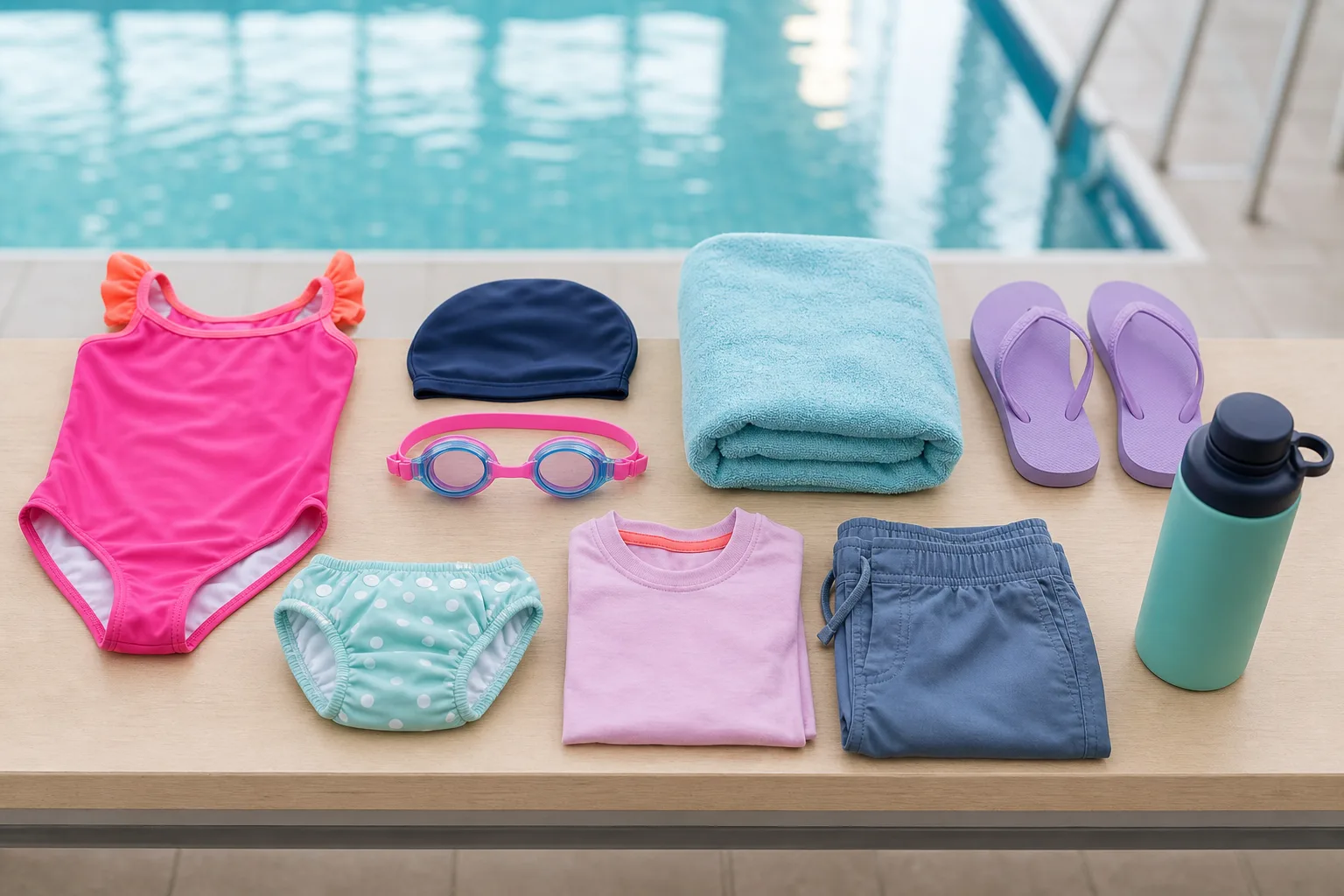
The provider's rules should take priority, but a typical bag includes:
- a comfortable, close-fitting swimsuit;
- a swim cap if required;
- goggles if the instructor recommends them;
- flip-flops or other poolside footwear;
- a towel and complete change of dry clothes;
- a suitable swim nappy for a child who is not toilet-trained;
- a reusable water bottle;
- any access or communication aid agreed with the instructor.
Label belongings and arrive early enough that changing does not become the most stressful part of the lesson.
Helping a nervous child begin
A cautious start is not a failure. Useful steps include:
- visiting the building before the first class;
- showing the child where they will change and where the caregiver will wait;
- introducing the instructor before entering the water;
- describing one or two concrete things that will happen instead of promising it will be "easy";
- agreeing with the instructor on a gradual first-session goal;
- praising a specific effort, such as sitting at the edge or putting their face near the water.
If distress continues, discuss a different time, group, teacher or format. The objective is steady learning and a healthy respect for water, not forcing rapid progression.
Where lessons fit in the rest of the water year
Weekly lessons are the structured part, but most of what makes a child comfortable in water happens outside them — which is also where the skills get tested.
- Our guide to water activities for kids covers surf, sailing and SUP alongside swimming, with the real starting ages schools use and current prices, including the Oeiras pools mentioned above.
- Our guide to safe beaches for kids in and around Lisbon is the companion piece for open water, where conditions and supervision work very differently from a pool.
- For general weekend planning, the Lisbon family weekend guide is updated with what is actually on.
Find current swimming options on KidsToGo
Use the KidsToGo swimming search for Lisbon to see what is currently listed, then confirm the programme details directly with the provider before paying or travelling.
When comparing results, check the child's age, exact location, timetable, booking method and whether the listing describes a lesson, free-swim session or a different water activity.
Last reviewed: August 2026. Availability and prices may change; the linked operators remain the authoritative source for current enrolment information.
Sources and verification record
- American Academy of Pediatrics: Swim Lessons — When to Start and What to Consider — starting age, infant lessons, supervision and programme-selection guidance.
- World Health Organization: Guideline on basic swimming and water-safety skills — role of basic swimming and water-safety education in drowning prevention.
- IPDJ: Título Profissional de Treinador de Desporto — Portuguese professional coaching credential.
- Portuguese Swimming Federation: À Prova de Água — Portuguese aquatic readiness and survival programme.
- APSI — Associação para a Promoção da Segurança Infantil — Portuguese child-safety organisation.
- Oeiras Viva — municipal pool network for the Oeiras area, including baby swimming programmes.
- Lisbon Municipality facility pages for the Casal Vistoso, Oriente and Restelo pools, and the council's 2025/26 sports-facility price table — minimum age, pool configuration and published fees. These pages were read directly in an earlier fact-check pass; the council's directory now blocks automated requests, so confirm current details by phone.
This guide was fact-checked in August 2026 against the sources above. Where a source could not be re-read directly, we have said so rather than restating it as current.

kidstogo
KidsToGo is the leading platform for discovering kids activities in Portugal. We help families find the best experiences — from creative workshops and sports to outdoor adventures — so every child can learn, play, and grow.