
Signs Your Child Is Ready for Group Activities

kidstogo

The first group activity is a bigger step for the parent than for the child, and the anxiety it produces is mostly about a question that has no answer: are they ready?
We are going to take that question apart rather than answer it, because framed that way it invites you to assess your own child against a standard nobody set. What actually helps is knowing which conditions make a first class go smoothly, what a normal difficult start looks like, and how to prepare for it.
This is not a test
Nothing on this page is a checklist to pass. There is no age at which a child becomes ready, no number of boxes to tick, and no child who is behind because a first class went badly.
Children arrive at group settings unevenly — confident about some parts, hopeless at others, and different again three months later. If your child does none of what follows, the reasonable conclusion is that a particular class on a particular Tuesday might be hard, not that something is wrong.
What we changed in this guide
This guide used to read as a readiness assessment, and we have rewritten it.
We removed a set of numeric thresholds that were never measured: that a child should be able to wait "2-3 minutes", concentrate for "10-15 minutes" at three and "20-25 minutes" by five, and that distress persisting past "4-6 sessions" or "4-6 weeks" indicates a problem. Numbers like these turn ordinary variation into a diagnosis.
We also removed a section listing reasons to delay that had drifted well past our competence — describing patterns of avoidance and panic in social settings, "consistently aggressive or dysregulated" behaviour, and communication delays for which it suggested working with a speech therapist. We are a place to find children's activities. We are not qualified to help you assess your child for a developmental or behavioural condition, and we should not have published something that reads as though we are. What replaces it is at the end of this guide.
Finally, we cut the age-banded tables of recommended activities, which duplicated our activity guide by age. That guide owns the question of what suits which age.
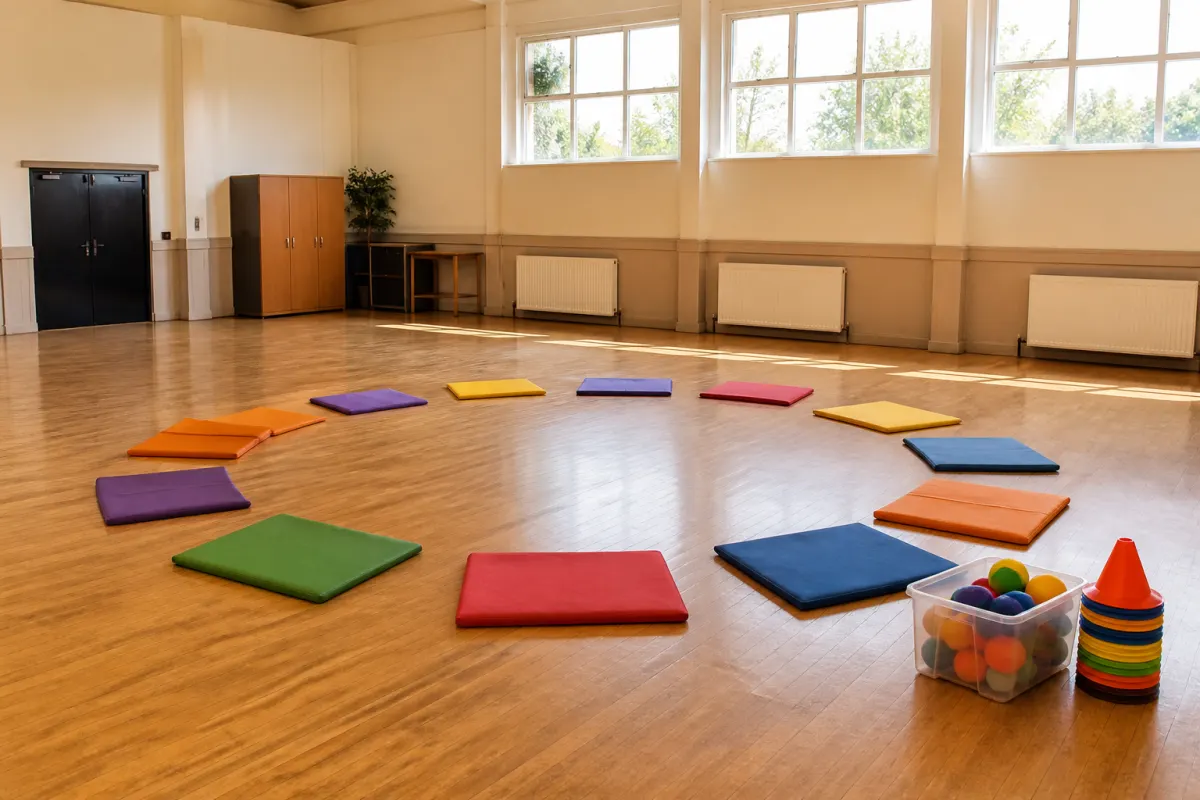
What makes a first class easier
These are conditions, not requirements. The more of them that happen to be true, the smoother a first session tends to go.
Around separating and settling
They can recover after you leave. Not that they will not cry — plenty do — but that the crying stops and something else starts. Instructors see this every week and will tell you honestly how long it lasted if you ask.
They accept direction from adults who are not you. If grandparents, nursery staff or a family friend can already get co-operation, a coach probably can too.
They can be frustrated without it ending the session. Losing a game, waiting a turn, not getting the red one. Managing that imperfectly, with help, is the normal version.
Around other children
They are interested in other children. Watching counts. Approaching counts. A child who consistently seeks other children out at the playground brings that with them into a class.
They have moved from playing alongside to playing with. Assigning roles, sharing a project, arguing about the rules of a game they invented — that shift usually arrives somewhere in the preschool years and it makes group activity much easier when it does.
They can say what they need. Not eloquently. Just enough to manage the essentials — needing the toilet, not liking something, asking for help. This one matters more than the others, because it is about being looked after properly when you are not in the room.
What a normal start looks like
Expect a first session to be unrepresentative, and expect the first few to be lumpy.
At the younger end, a lot of watching, intermittent joining in, and tears at drop-off are all ordinary. Sessions are short for a reason. Somewhere in the preschool years, most children shift towards genuine enthusiasm punctuated by shyness, arguments over sharing, and the occasional falling-out — all part of it rather than signs it is going wrong. By school age, following instructions and understanding the rules of a game get much easier, and friendships rather than the activity itself often become the reason they want to go.
The one thing worth watching across all of it is the direction of travel. Week four being easier than week one tells you more than any single session does.
Preparing for the first session
Before
- Go and look at the venue while a class is running, before you sign up. Let your child see the room, and meet the instructor if possible.
- Describe what will happen, specifically and honestly. "There will be games, other children, and a teacher called Ana" beats "you'll love it" — which sets up a promise you cannot keep.
- Read a book about starting something new. It gives a child a way to rehearse the feeling.
- Practise being apart in small doses first, if they never have been — an hour with grandparents before a term of Saturday mornings.
During the first few weeks
- Have a short, identical goodbye every time. A hug, one sentence, then go. Drawing it out reliably makes it worse.
- Be early at pick-up, especially in the first weeks. Being there before they look for you is worth more than anything you say.
- Ask specific questions afterwards. "What did you play?" and "who were you with?" get real answers; "did you enjoy it?" mostly teaches children to say yes.
- Do not judge it on the first tears. Talk to the instructor about what happened after you left, which is usually a different story from the one you witnessed at the door.
Temperament is not readiness
This is the distinction the whole guide turns on, and it is the one most often got wrong.
A quiet child is not an unready child. Some children prefer to watch a while before joining, make one or two friends rather than ten, and need time alone afterwards to recover from a noisy hour. None of that is a deficit and none of it means waiting.
What it means is choosing differently: a smaller group, a calmer room, an instructor who notices the child at the edge and does something proportionate about it. The same child who would be miserable in a class of twenty can be perfectly happy in a class of eight.
If you are genuinely worried
Sometimes a parent's unease is not about the class at all.
We are not going to give you a list of signs to check your child against — a checklist in a blog post is a poor instrument, and it tends to generate worry rather than resolve it. The better version is straightforward: if you are concerned about your child's development, communication, or how they are coping socially, and that concern persists across settings rather than just at one activity, talk to your paediatrician or your centro de saúde. They can assess your child properly, which no article can.
In the meantime, if a full group feels like too much, there are gentler bridges: a playdate with one or two children rather than a room of them, open play spaces where your child sets the pace, and parent-accompanied classes, which exist precisely for this. Our guide on separation anxiety in activities covers the settling-in problem in more depth.
And if the honest answer is simply "not this term", that is a complete answer. Nothing here is time-limited.
Related guides
- How to choose the right activity for your child — the decision process, once you are ready to pick.
- First day of activities: how to prepare your child — the day itself, in detail.
- How to handle separation anxiety in activities — when the goodbye is the hard part.
- Activity guide by age: from 0 to 12 years — what tends to suit each stage.
Find activities on KidsToGo
Browse what is listed near you with the KidsToGo activity search for Lisbon, filtering by age and area. When you contact a provider, ask about group size and how they handle a child who is slow to join in — the answer tells you a great deal.
Last reviewed: August 2026. This guide was fact-checked in August 2026 and deliberately contains no developmental, behavioural or diagnostic claims. For any concern about your child's development or wellbeing, speak to your paediatrician or centro de saúde.

kidstogo
KidsToGo is the leading platform for discovering kids activities in Portugal. We help families find the best experiences — from creative workshops and sports to outdoor adventures — so every child can learn, play, and grow.